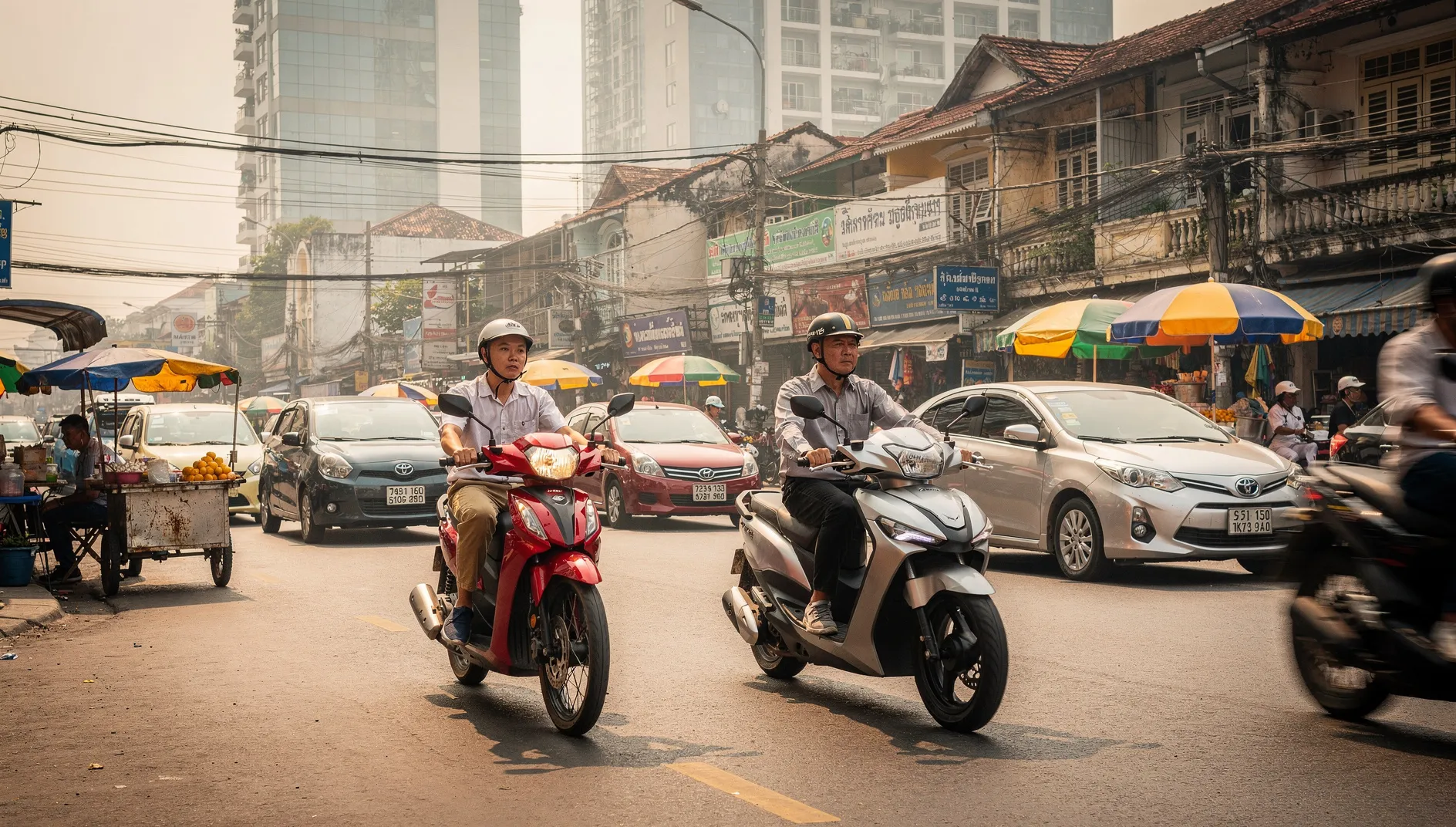
Honestly, choosing between a 125cc motorcycle and an electric scooter in Asia isn't just a matter of price! Between Bangkok’s massive traffic jams, Hanoi’s totally crazy traffic, and the electric ojek that are revolutionizing Jakarta, every city has its own set of rules. So, I tested both options in these three cities to give you the real comparison—the one you won’t find anywhere else.
The daily commute showdown: 125cc motorcycle vs. electric scooter
Honestly, my first day in Bangkok will stay with me forever! I’d rented a little Honda Click 125cc, proud to finally be exploring the Thai capital on two wheels. The result? Stuck in a massive traffic jam on Sukhumvit Road, my bike refusing to start again in the sweltering heat, and me sweating buckets in the thick smog… So I quickly realized that choosing a vehicle in urban Asia isn’t just a matter of personal preference!
Asian metropolises are a world apart when it comes to traffic. Bangkok, with its 10 million residents and 8 million vehicles fighting for a few meters of road; Hanoi, with its 8 million people and 6 million motorcycles weaving between buses; or Jakarta, where 10.5 million people share the streets with 14 million vehicles… Needless to say, the traffic density is insane!
For us expats and digital nomads, two main options are available: the good old 125cc gas-powered motorcycle or the next-generation electric scooter. The motorcycle is the traditional choice—reliable, powerful, with a repair network everywhere. The electric scooter is the future knocking at the door with its eco-friendly promises and tech innovations.
In fact, Asian governments are pushing hard for electric vehicles! Indonesia aims for 2.1 million electric vehicles by 2025, Thailand is relying on tax incentives to boost sales, and Vietnam is rapidly expanding its charging infrastructure. As a result, we’re truly witnessing a historic transition in these megacities where breathing can sometimes become a daily challenge!
Bangkok: Between Combustion Engine Tradition and the Electric Revolution
Bangkok, a metropolis of 10 million people where traffic jams are legendary! Between the weaving tuk-tuks, the buses belching black smoke, and the pollution that chokes you… Choosing your mode of two-wheeled transport becomes a strategic decision. After testing both options for months, here’s what you need to know before venturing into Thailand’s urban jungle.
Actual costs and hidden fees
The Honda Wave 125cc is the classic choice for Bangkok residents: rental costs between 2,500–3,500 THB per month, with gas at 35–40 THB per liter (expect to spend about 1,000 THB/month for daily use). Mandatory insurance will cost you 3,000 THB per year, and don’t forget the approved helmet, which costs at least 800 THB!
But watch out for hidden costs! From experience, a gas-powered motorcycle will cost you an average of 1,500 THB per month in various repairs: broken chains, brake pads, oil changes… Pollution and driving in traffic really take a toll!
As for electric models (Gogoro or NIU), the monthly rental fee ranges from 4,000 to 5,500 THB. On the other hand, charging will only cost you 15–25 THB per 100 km! And if the battery fails, expect to pay 200 THB for a replacement. The only catch: some charging stations in shopping malls now charge a fee.
Essential apps and safety tips
Honestly, without Grab, you’re lost! This app compares taxi prices and gives you a real-time traffic update. ViaBus is a lifesaver for avoiding traffic jams by following the Bus Rapid Transit (BRT) routes. And Bangkok Traffic is your best friend for planning your trips during off-peak hours.
For safety, an anti-pollution mask is a must! Especially during the dry season when the air becomes unbreathable. Avoid Sukhumvit Road at all costs between 7 a.m.–9 a.m. and 5 p.m.–8 p.m.—it’s hell on earth. And always, ALWAYS, park your vehicle in a secure parking lot (20–50 THB per day)—theft is common in this city.
Expat testimonial: Marie, a digital nomad for 2 years
"At first, I was 100% Team Gasoline Motorcycle! Cheaper, longer range… But after two breakdowns in the middle of the monsoon season and constant repairs, I fell for an electric NIU. Yes, it’s more expensive to rent, but zero mechanical stress!
The real hassle with electric? Finding an available charging station in tourist areas. So, I always charge at home in the evening. My advice after two years in Bangkok: if you’re staying less than six months, get a Honda Wave. Beyond that, electric becomes cost-effective and so much more pleasant! Quieter, no gasoline smell, and honestly, with all this constant pollution, it’s a small gesture for the planet that’s good for your morale."
Hanoi and Jakarta: Urban Challenges, Tailored Solutions
After Bangkok, we head to two other Asian megacities where two-wheelers reign supreme! Hanoi and Jakarta each present unique challenges for urban riders.
Hanoi: the organized chaos of two-wheelers
Honestly, Hanoi is on another level! Vietnamese traffic is a work of art. I still remember my first time crossing the street near Hoan Kiem Lake… Motorcycles come from everywhere, but strangely enough, it works! The secret? Walk slowly and predictably. Drivers anticipate your movements.
As for costs, renting a Honda Blade or Wave Alpha will set you back between 1.8 and 2.5 million VND per month (or €70–95). Gas costs about 23,000 VND per liter. For electric bikes, options are still limited: VinFast Klaras rent for between 3 and 4 million VND per month.
As for apps, Grab Vietnam dominates, but Be is gaining ground for transportation. Zalo Maps remains essential for navigation—Google Maps sometimes struggles in the narrow alleys of the Old Quarter.
Watch out for massive potholes! And above all, avoid the historic center between 5 p.m. and 7 p.m.—it’s hell. Wearing an anti-pollution mask is becoming truly essential, especially in winter when the smog lingers.
Jakarta: sprawling megacity and extreme pollution
Jakarta is another world! This megacity of 10 million people lives to the rhythm of the “ojek”—those motorcycle taxis that weave their way everywhere. Today, the electrification of ojek is underway with Gojek and its partners.
For a Yamaha Mio rental, expect to pay 800,000 to 1.2 million IDR per month (€50–75). Gasoline remains cheap: 10,000 IDR per liter. On the electric side, Gesits or United Motors can be rented for between 1.5 and 2 million IDR per month.
Gojek is THE must-have super-app! Transportation, delivery, payments… everything goes through it. Grab Indonesia is still around but less dominant than elsewhere.
Safety is critical! Torrential rains turn the streets into rivers. In fact, during the rainy season, certain neighborhoods are regularly flooded. Also watch out for helmet theft—very common at traffic lights. And then there’s the traffic restriction system based on license plates… It’s really not easy for newcomers!
Comparison chart and final verdict
After spending months exploring the streets of these three Asian metropolises, here’s the concrete comparison you’ve all been waiting for! Because frankly, there’s sometimes a world of difference between marketing promises and the reality on the ground…
| Criterion | Bangkok | Hanoi | Jakarta |
|---|---|---|---|
| Total monthly cost (125cc motorcycle) | €95–120 | €70–95 | €85–110 |
| Total monthly cost (electric) | €140–180 | €120–150 | €160–200 |
| Range/Fuel consumption | 350 km (4 L/100 km) vs. 80–120 km | 400 km (3.5 L/100 km) vs. 60–100 km | 300 km (4.5 L/100 km) vs. 70–110 km |
| Charging/refueling time | 2 min vs 2–4 hrs | 2 min vs. 3–5 hours | 2 min vs. 2–3 hours |
| Parts availability | Excellent vs. Limited | Excellent vs. Low | Good vs. Average |
| Ease of parking | 7/10 vs 8/10 | 6/10 vs 7/10 | 5/10 vs 9/10 |
| Pollution level | 6/10 vs 9/10 | 4/10 vs 9/10 | 3/10 vs 9/10 |
| Available apps | Grab, Bolt vs EV Station | Grab vs Vinfast | Gojek, Grab vs PLN Mobile |
| Road safety | 6/10 | 5/10 | 4/10 |
Hidden Costs Often Overlooked
Now, watch out! These little surprises can quickly blow your travel budget. First, emergency repairs: expect to pay €30–80 for a serious mechanical issue on a traditional motorcycle. Electric scooters? It’s rarer, but when they break down, it’s expensive: easily €100–200.
Next, theft and vandalism—a sensitive topic! In Bangkok and Jakarta, a poorly parked motorcycle can vanish overnight. Anti-theft budget: at least €20–40. Parking tickets? €5–15 per violation, and believe me, they add up fast when you’re not familiar with local regulations.
Finally, wear and tear from urban pollution: your brakes, your chain—everything wears out faster. Add 20–30% to your maintenance budget in cities like Jakarta or Hanoi.
Verdict based on your profile
Budget-conscious backpacker: Go for a 125cc motorcycle without hesitation! Especially in Hanoi, with reliable Honda Blades and cheap gas. You’ll save at least €50/month, and honestly, when you’re traveling on €30/day, that makes a difference!
Comfort-seeking digital nomad: Electric in Bangkok and Jakarta. No more gas fumes, noise, or vibrations during your video calls. More expensive, but your quality of life and productivity are worth it.
Long-term expat: A mixed approach! Bangkok → electric for daily comfort. Hanoi → traditional motorcycle for ease of maintenance. Jakarta → electric if you stay in the city center, traditional if you explore the outskirts.
My honest advice after 3 years in urban Asia
Honestly, after 3 years navigating these crazy metropolises, here’s my personal recommendation: always start by testing both options for a week. Reputable rental companies will give you a discount if you extend your stay.
My preference? Electric in Bangkok (top-notch infrastructure), 125cc motorcycle in Hanoi (Vietnamese pragmatism), and… Gojek in Jakarta! Sometimes, the best motorcycle is the one you don’t have to drive yourself in this urban chaos.
Crucial safety reminder: ALWAYS wear a helmet (even at 40°C), local insurance is mandatory, and learn the local traffic rules. Accidents happen fast, and private hospitals in Asia cost a fortune. Stay safe!